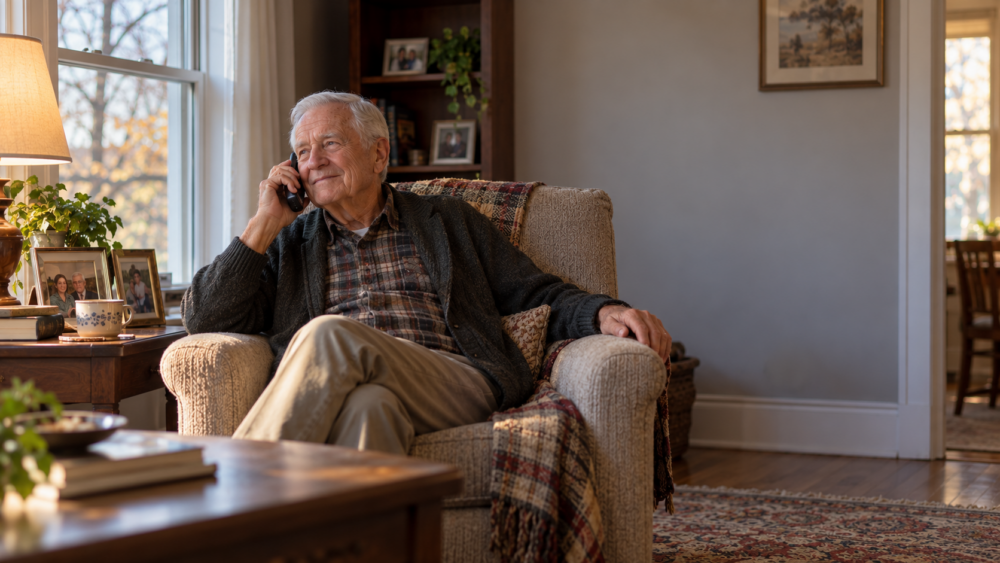
He said he was fine. He always says he’s fine.
But somewhere in the call he mentioned he hadn’t got to the store this week, and when you asked about the follow-up appointment he went a bit vague and started talking about the neighbor’s dog instead. Now it’s eleven at night, you’ve got work in the morning, and you’re lying there three hours away doing the arithmetic on whether you could get out there Friday.
That particular brand of helplessness doesn’t get talked about much. You’re not the one doing the lifting, so it feels like you’ve got no business being tired. But you’re carrying the worry all day every day, and worry you can’t act on is heavier than people give it credit for. It’s a version of something we’ve written about more broadly: what happens when caring for a parent starts to consume your life.
Some of this distance just doesn’t solve
Worth saying plainly, because long-distance caregivers burn a lot of energy on problems that have no remote fix.
You can’t see how he’s doing. Phone calls flatten everything, and people go on sounding like themselves long after they’ve stopped coping. You can’t catch the slow stuff either — weight coming off, the house getting away from him, laundry stacking up in the spare room. That shows up to the eye, not the ear. You can’t get there quickly, and three hours is three hours no matter how you feel about it. And you can’t check what he tells you, because parents protect their kids from worry, and “everything’s fine” is sometimes a kindness rather than a lie.
None of that is a reason to give up. It’s just worth knowing which parts to stop fighting, so you can put the effort somewhere it lands.
What you can do from anywhere, and do well
More than people expect, as it happens, and most of it is the administrative weight that grinds down whoever’s local.
Take the paperwork — all of it
Insurance calls, scheduling, bills, refills, benefit applications. None of it needs you in the room, all of it eats hours, and it’s reliably the part that burns out a hands-on caregiver. If your sister in Boardman is doing the physical care, lifting the entire admin load off her is not the lesser job. Counted in hours it’s often the bigger one.
Build the one document everybody works from
Medications and doses, conditions, doctors, the pharmacy, insurance details, emergency contacts, who’s got a key. Shared where anyone involved can get at it. The CDC has a sensible framework for this in its steps for creating and maintaining a care plan. It’s an afternoon’s work and it saves an extraordinary amount of confusion the first time something actually goes wrong at two in the morning.
And call on a schedule. Same days, same time, even if the calls are short. It gives him something to look forward to, and it gives you a baseline — you’ll hear a change in him far sooner when you’ve got a steady pattern to hear it against.
Getting somebody’s eyes on him in Youngstown
This is the real answer to distance. Not an app, not calling more often. Somebody local who can tell you the truth.
Start with who’s already there
Neighbors, his church, the friends he’s had for forty years. Northeast Ohio is decent at this sort of thing, and swapping numbers with the woman across the street costs nothing. Ask her to ring you if something seems off — most people are pleased to be asked, and a bit relieved somebody’s paying attention.
The limit of that is consistency. Neighbors are generous and they’re also busy, and nobody wants to be the one who has to decide whether a thing is serious. A caregiver on a set schedule is different in kind: somebody who knows what they’re looking at sees him every week and tells you afterward how he really seemed. Families who use our respite care in Ohio for this usually start with one or two visits a week around Youngstown or Boardman. The visit matters less than the fact that it happens reliably and that you hear about it.
It’s also worth seeing what the state already runs. November is National Family Caregivers Month, which is as good a prompt as any. The Ohio Department of Aging’s caregiver support resources connect families to their local Area Agency on Aging, which administers caregiver support and respite programs across the state. People doing long-distance caregiving in Youngstown skip that step constantly, on the assumption it’s only for families who live there. It isn’t.
When you do get out there, actually look
Your visits are rationed, so don’t spend all of them being sociable. A few minutes of quiet inspection tells you more than a month of phone calls.
Open the fridge. Look at the pile of mail and see whether envelopes are getting opened. Count what’s left in the pill bottles against what ought to be. Notice whether the house is as clean as he’d have kept it five years ago, which is a different question from whether it’s clean. Watch him get out of a chair, take the stairs, carry something across the room.
Then put the clipboard down and spend some of the time just being there with him. If you want something to do that isn’t an errand, these seasonal activities for seniors around Youngstown are a reasonable place to start.
Distance doesn’t make you less of a caregiver
You moved for a job, or a marriage, or because that was the life available to you at the time. It was a perfectly reasonable decision and it doesn’t mean you abandoned anybody, whatever the three-in-the-morning version of your brain has to say about it.
It does mean your caregiving has to take a different shape. More coordinating, less hands-on, and somebody real on the ground standing in for the proximity you haven’t got.
If you’d like help setting that up for a parent in Youngstown, Boardman or the counties around them, get in touch with Sunny Days In-Home Care Ohio or call (330) 610-7890. We work with a lot of out-of-town families, and keeping you properly in the loop is part of the job rather than an extra.