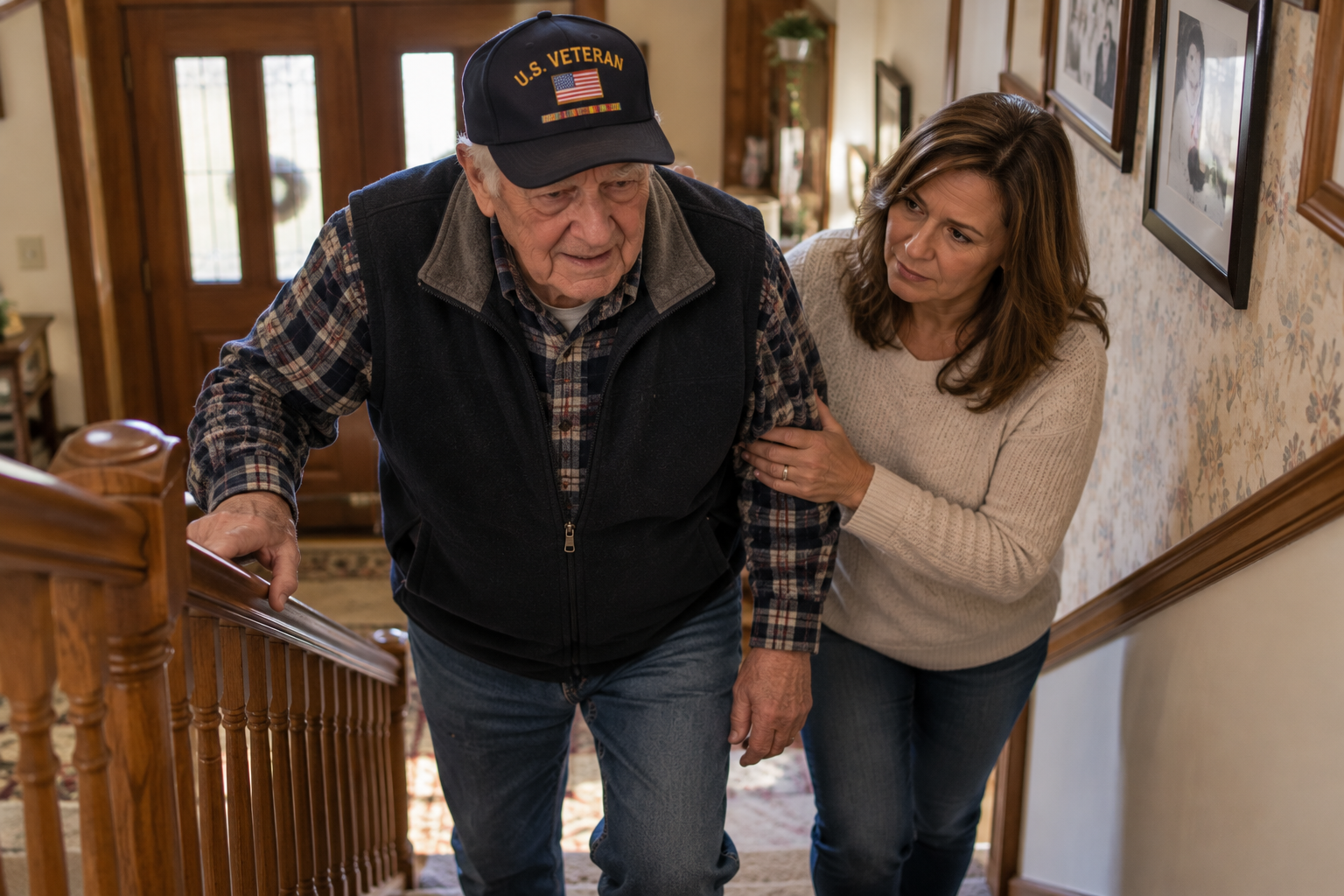
Your dad has never asked anybody for help in his life. He served, he worked, he fixed what broke around the house. Now the stairs take him a while, the pill organizer has Wednesday still full on Friday, and he tells you he’s got it handled.
If he wore the uniform, there’s money on the table that most families never claim. VA home care benefits in Pittsburgh can cover some or all of the day-to-day help that keeps a veteran in his own house. Our broader guide on how to pay for in-home care covers Medicare and Medicaid. This one sticks to the VA.
Why Families Leave This Money Unclaimed
We hear the same few reasons from families in Bethel Park, Mt. Lebanon, Canonsburg, Washington, and Greensburg.
He wasn’t wounded, so he figures benefits aren’t for him. He made too much money. He never enrolled in VA health care, so he assumes that door closed years ago. Or he simply won’t be the guy asking the government for something.
None of those are answers. They’re assumptions, and eligibility depends on details nobody can guess from the outside. One phone call settles it.
The Programs That Pay for Help at Home
Homemaker and Home Health Aide care
Through the VA’s Homemaker and Home Health Aide program, an aide comes to the house and helps with the things that have gotten difficult:
- Bathing, dressing, shaving
- Meals and getting to the bathroom
- Moving around the house without a fall
- Groceries and errands
The VA says enrolled veterans can be eligible if they qualify for community care and meet the clinical need. How much help he gets is based on an assessment, not a formula. There may be a copay depending on his service-connected disability status. The aides come from agencies under contract with the VA.
Aid and Attendance
If your dad already draws a VA pension and needs another person’s help with everyday tasks, Aid and Attendance adds to that monthly payment. Some surviving spouses qualify too. It arrives as money, not services, which means it can go directly toward care hours on whatever schedule works.
Help for whoever is doing the caregiving
That’s usually you. VA Pittsburgh’s Caregiver Support Program runs skills training, coaching, and peer support for family caregivers. The local coordinator is at (412) 822-2364, and the national support line is 1-855-260-3274.
Getting Started Without Drowning in Paperwork
Find the DD-214
It’s the discharge paperwork, and it proves everything. Check the desk, the fireproof box, the folder in the basement labeled something unhelpful. If it’s truly gone, copies can be requested.
Check whether he’s enrolled in VA health care
A lot of home care runs through it. If he never enrolled, that’s usually step one.
Ask to talk to a social worker
This is the part families get wrong. When they ask what’s hard, don’t summarize. Say that he can’t get out of the tub without help, that he skipped two showers last week, that he stopped cooking in March. Details decide what gets approved.
Assume it takes a while
It usually does. Most families start a few private-pay hours in the meantime rather than let the situation sit.
When the VA Covers Part, Not All
This happens often. Benefits might cover three visits a week when what your family actually needs is five, or they might cover mornings when the risky hours are in the evening.
Families across Allegheny, Washington, and Westmoreland counties mix sources all the time: VA hours plus private pay, or VA benefits alongside Pennsylvania’s Medicaid waiver if they qualify. Our home care for veterans page explains how we build around benefits instead of duplicating them, and our overview of the types of care we offer can help you figure out what to ask for.
Two Questions We Get Constantly
Does he need a service-connected disability?
Not necessarily. Some programs turn on clinical need rather than a rating, though a rating can affect copays. Ask the VA about his specific situation rather than guessing from what a friend told you at the Legion.
What about my mother, after he’s gone?
Surviving spouses may qualify for certain VA pension benefits, including Aid and Attendance. It depends on her circumstances, and it’s worth asking rather than assuming the benefits ended with him.
How to Bring It Up With Him
Careful how you open. “You need help” lands like an accusation to a man who spent his life being the one who helps.
What works better is treating it as something he earned. He paid into this. He served, and these benefits exist for exactly the situation he’s in now. A lot of veterans will accept an aide as a benefit they’re owed long before they’ll accept one as charity or as proof they’re slipping. Start there, and start with the tasks he already gripes about, like the laundry or the grocery run.
Who You Send Matters More With Veterans
A proud man who spent forty years not needing anybody does not warm up to a stranger reorganizing his kitchen.
What works is the same caregiver every visit, someone who helps without hovering and lets him do what he can still do himself. It also helps when they’ve got something to talk about, whether that’s the Steelers, a boat, or the fact that her father served too. That’s not a small thing. It’s usually the difference between a veteran who accepts help and one who cancels after two weeks.
Let’s Sort Out What He’s Owed
Our Southwestern PA team works out of Canonsburg, and we’ve walked plenty of families through this. Call us and we’ll tell you what we know, what we don’t, and who to ask next.
Contact Sunny Days In-Home Care Southwestern PA or call (724) 900-4013.